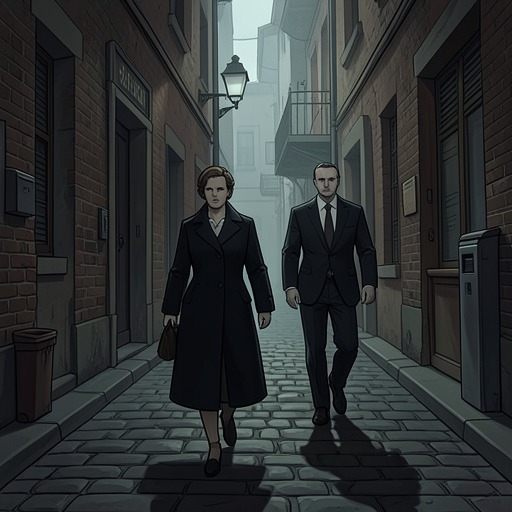
Leni
Kiss of the Spider WomanLeni is a celebrated singer performing in Paris whose romance with a German officer draws her into a dangerous conflict between private attachment and resistance work. Her story moves from a glittering music hall to a clandestine mission and ends with her death; its theatrical songs and images turn that trajectory into a drama of love, compromised loyalties, and sacrifice.
Identity and Introduction
Leni first appears as the central performer in a famous Paris music hall. The show frames her entrance through spectacle: a chorus number shifts from black costumes and banana skirts to blonde performers in rhinestones, then the stage darkens and Leni emerges through layers of hanging tulle in a close-fitting silver lamé gown. She is described as very tall, with the long, slender profile fashionable at the time. The visual presentation establishes her as both a working singer and an image carefully composed for an audience.
Her performance carries unease beneath its glamour. Leni sings first in French and then in German, high above the stage before descending along illuminated steps. During the song, she stares into the darkness with a frightened expression and seems to surrender rather than resist whatever awaits her. The contrast between her controlled stage presence and that fear gives the number a foreboding quality before the story has explained its cause.
After the performance, Leni exchanges quick looks with a German officer. In her dressing room she finds a beautiful bouquet without a card. A blonde chorus girl then arrives, excited to tell Leni first that she is pregnant. The girl is unmarried, but says the father is a German officer who loves her and that they are arranging to marry. Her happiness is shadowed by a fear she dismisses as foolishness, leaving Leni alone with an unanswered warning.
Romance and the First Warning
The German officer and Leni soon fall deeply in love. Each night she dedicates songs to him, especially a habanera staged as a tropical harbor: silver-paper palms, a sequined moon reflected on a silk sea, maracas imitating waves, and a cardboard yacht at the dock. The elaborate artificial setting makes their romance part of the theater’s constructed world, while the repeated public dedications make the relationship visible through Leni’s work.
The earlier chorus girl’s story later acquires a darker significance. She had also been involved in a mission for the French resistance organization, but after beginning an affair with a German lieutenant she fell in love with him and refused to continue cooperating. The account says she was killed before she could denounce the group. Leni is approached as a replacement for the mission the girl began but did not complete. The parallel places Leni’s own romance under a warning: affection for a German officer has already intersected with resistance work and fatal consequences.
A Resistance Mission
A driver who had been associated with the clubfoot brings Leni into contact with people working for the French resistance organization. They ask her, a Frenchwoman, to help uncover the location of a major German ammunition dump in France, so that German forces’ enemies can destroy it. Leni is frightened but conceals that reaction. The mission asks her to cross from the intimate world of her romance into a political struggle whose stakes extend well beyond the theater.
Leni does not simply accept the request without conditions. She insists that, before she can be persuaded to disclose the arsenal’s location, she must meet the organization’s high command. On the journey from Paris, she arranges for the German officer and his soldiers to follow her. The driver notices the pursuit and changes direction to break the trail. He then takes Leni to a castle, where she is presented to the head of the French resistance organization: the Butler / maquis leader, who had been spying on her. The meeting reveals that the mission is shaped by surveillance and competing plans, not by a straightforward passage from recruitment to cooperation.
Death and Memorial
Leni’s story ends after she is shot. The German officer reaches her and understands from the blood on his hands that she has been seriously wounded. He kisses her, but when he draws back she is already dead. The scene closes the romance through a final encounter in which the officer arrives too late to save her; the account does not settle every detail of the wound, but makes her death unmistakable.
The final image transfers Leni from a living performer to a figure of public commemoration. In a Berlin Pantheon for heroes, she appears like a statue in a Greek tunic, her face whitened, with her arms extended. The officer places flowers on her arms and leaves beneath a light that seems to descend from above. Her theatrical image thus survives in monumental form, but the beauty of the tableau is inseparable from the loss it commemorates.
Narrative Role
Leni’s plot is built from contrasts between performance and danger. Her first song is visually dazzling but emotionally frightened; the habanera makes love into a nightly public dedication; the mission then turns the officer’s pursuit and the driver’s route into elements of a covert operation. The stage’s fabricated moon, sea, and yacht echo the uncertainty of a romance unfolding amid espionage, without making the danger itself merely theatrical.
The account also links Leni to the blonde chorus girl through repetition with a consequential difference. Both women’s relationships with German officers touch the resistance struggle, and both face the costs of that entanglement. The earlier woman refuses to continue her mission after falling in love; Leni is recruited to take up the unfinished task, but her own course proceeds through a meeting with the resistance leadership and ends in death. The closing monument gives her story a heroic visual finish while preserving its central contradiction: the performer made luminous for an audience is also a person caught in a conflict that her songs cannot resolve.